
Stable funding as a prerequisite for cutting-edge research
Fri Dec 12 10:03:42 CET 2025
Fri Dec 12 10:03:42 CET 2025 | Fri Dec 12 10:03:42 CET 2025 - Fri Dec 12 10:03:42 CET 2025
The government's decision to cut funding for research and development comes at a time when the share of public spending on science has been declining for a long time. According to Eurostat data, total R&D expenditure in the European Union is around 2.24% of GDP, while the Czech Republic continues to invest less (around 1.8–2% of GDP), which places it below the EU average and confirms the need to strengthen stable funding for science.
In recent years, the Czech Republic has faced high inflation, which averaged 15.1% in 2022 and was still around 10.7% in 2023. If science funding remains nominally the same or even declines, support weakens significantly in real terms.
This development puts Czech scientific institutions in a difficult position. Without stable and predictable financial support, their ability to compete in the long term with countries that invest steadily in science is reduced. Scientific teams working at the international level compete for talent in a global market, and a stable environment is essential for their growth.
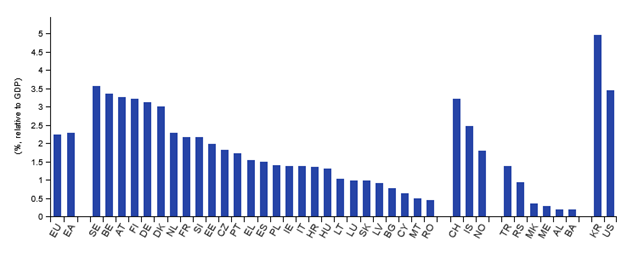
Obr.: Hrubé domácí výdaje na výzkum a vývoj, 2024, Eurostat
https://ec.europa.eu/eurostat/statistics-explained/index.php?title=R%26D_expenditure
Investments that have paid off: from EXPRO to ERC Synergy
The experience of the Institute of Biotechnology of the Czech Academy of Sciences illustrates these connections. Zdeněk Lánský's project, funded by the GA ČR EXPRO program, yielded fundamental insights into the mechanism of intracellular mitochondrial transport. The results of this basic project were subsequently followed up by an ERC Synergy Grant, the most prestigious European scientific grant, which Zdeněk Lánský's team received for research into the regulatory mechanisms of the tubulin protein and its role in neurodegenerative processes.
The project was developed in collaboration with leading institutions CNRS (France), INSERM (France), and the University of California, Berkeley (USA).
Such a significant connection would not have been possible without the prior support of long-term and demanding basic research provided by the GA ČR and the Czech Academy of Sciences. It is these institutions that create the conditions that enable Czech scientists to succeed in European competition. If the conditions for basic research had been weakened in the past, the Czech team would probably not have achieved this level of recognition at all.
The risk of losing talent in global competition
Cutting funding for science sends a signal that the scientific community abroad understands very well: the environment is not stable. This has two major impacts:
– it is more difficult to attract top scientists from abroad, who can choose from institutions in countries with long-term growth in science funding,
– we run the risk that current holders of prestigious grants will leave for elsewhere, because with an ERC grant it is possible to move to an environment with better conditions, more stable funding, and predictable support. Conversely, countries with a higher share of investment in science and stable science policies are strengthening their ability to attract talent and keep pace with technologically advanced countries.
The Institute of Biotechnology of the Czech Academy of Sciences strives to strengthen international cooperation and is receiving an increasing share of funding from European grants. The successes of recent years – two ERC grants, involvement in leading international consortia, and long-term high-quality scientific output repeatedly demonstrated by above-average evaluation results – show strong potential. However, in order to develop this potential further, it is essential that the scientific system as a whole remains competitive.
Basic research as a driver of innovation and future prosperity
The Institute of Biotechnology of the Czech Academy of Sciences is a basic research institution. It is basic research that lays the foundation for future innovation and solutions to complex biological and medical questions. Long-term investments in knowledge are investments with a high return – they enable the development of new technologies, support the emergence of collaborations, and increase the international visibility of Czech science.
Stable funding is therefore not just an administrative prerequisite, but a determining factor in whether the Czech Republic can keep pace with the most advanced countries and be a successful part of the global scientific community.
